This site uses cookies.
Some of these cookies are essential to the operation of the site,
while others help to improve your experience by providing insights into how the site is being used.
For more information, please see the ProZ.com privacy policy.
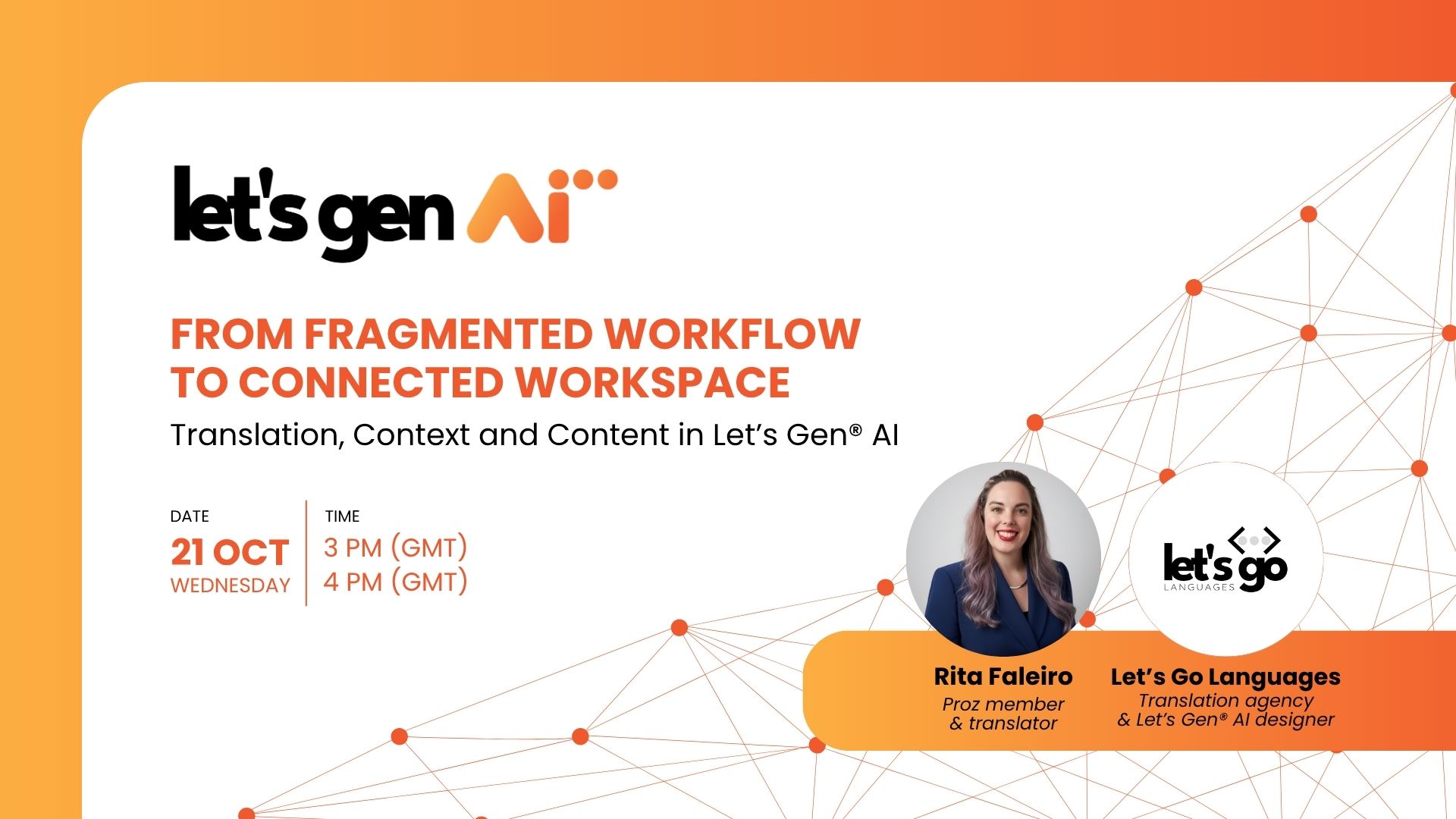
From Fragmented Workflow to Connected Workspace: Translation, Context and Content in Let’s Gen AI
In the localization process translation memories, terminology decisions, brand context, reviewer feedback, projects and content needs often live across several disconnected tools – which results in wasted time and inconsistency.
The session shows what changes when those pieces are brought into one environment — and where professional judgement is still indispensable.
It aims to recognise where fragmentation creates repeated work and inconsistency and helps you understand how a client workspace can preserve context across translation, content tasks and teams without losing the tone of voice.
See how client context can support content creation and localization without turning AI output into an unquestioned final deliverable.
VIA AILooking for an interpreter?
Remoto by ProZ.com connects you with an identity-verified interpreter by video or phone in about 60 seconds — 300+ languages, on demand or booked ahead.
Try Remoto »
Membro dal Oct '26
Lingue di lavoro:
Da Inglese a Greco Greco (monolingue) Da Italiano a Greco
Client-vendor relationship recorded successfully!
Eleni Perrikou has been added to your list of hired vendors.
This person has a SecurePRO™ card. Because this person is not a ProZ.com Plus subscriber, to view his or her SecurePRO™ card you must be a ProZ.com Business member or Plus subscriber.
Affiliazioni
This person is not affiliated with any business or Blue Board record at ProZ.com.
Servizi
Translation, Editing/proofreading, AI + Human review (MT post-editing), Transcreation
Esperienza
Specializzazione:
Medicina (generale)
Scienze sociali, Sociologia, Etica ecc.
Poesia e Prosa
Marketing/Ricerche di mercato
Portfolio
Traduzioni di prova presentate: 1
Da Inglese a Greco: Dead languages General field: Scienze sociali Detailed field: Linguistica
Testo originale - Inglese Do you know what language your ancestors spoke? Have you wondered how that language sounded?
Previously, I mistakenly thought that my ancestors, the great ancient Egyptians, spoke Hieroglyphics. It came to me that Hieroglyphic is the written system of the Egyptians’ spoken language which was simply called Egyptian, and later at some point, Coptic. Unfortunately, that is one of the dead languages now. Now, Egyptians speak Egyptian Arabic which is quite different. When I listen to this song in the ancient Egyptian language, attached below, I imagine, what if I were born 5000 years ago! I’d have spoken that language. I’d have prayed to the goddess Isis. As a sun lover, I’d definitely have followed Akhenaten when he created that new religion centered around Aten, the sun.
A few years ago, a traveler I met said that I looked like the queen Tiye, the mother of Akhenaten and the grandmother of Tutankhamun. Queen Tiye was known as a powerful woman and played an important role in foreign affairs. In her letters from foreign rulers, they expressed respect and admiration for her. She was also by the side of her son, Akhenaten, when he made significant religious reforms which included the “one God” concept.
That wasn’t the first time that someone said that I have pharaonic facial features which I couldn’t be more proud of. When I was a child, a member of my mother’s family used to call me Nefertiti. He thought that I looked as beautiful as her. What a great compliment! How happy I was every time I was called Nefertiti. In my own country, some people believe that I look more like an African than an Egyptian. Well, Egypt is situated in Africa and it’s an African country.
One day on the train from Aswan to Luxor, a ticket clerk asked whether I was a Sudanese. I asked him in return what he thought. He answered: “I have no idea! We all look the same.” I said: “Well, in the end, we’re one family that’s called humanity.” He smiled and left. The reason behind asking about nationality was because Sudanese, and generally non-Egyptians, had to pay a higher price, which I’m totally against. I don’t think any refugee has to pay anything for transportation or even accommodation in Egypt.
I know that my dark-skin color makes people suspect my Egyptianness, especially currently with the huge number of Sudanese refugees in Egypt who had to flee the awful war in their country.
In a supermarket in Safaga, a cashier wondered whether I was a Sudanese. She even commented on my accent and said it didn’t sound like an Egyptian one which raised my eyebrows. I wouldn’t mind being Sudanese, Ethiopian or Eritrean. As long as they label me as an African, it’s fine. I’m proud of my African features.
I remember that when we were young, my mother used to say that her grandmother was from the Nubians, an ethnic indigenous group in southern Egypt and northern Sudan. I'd say that I’m a mix of African, Egyptian and Nubian origins. All of this melted together to shape who I am now. It ties me to this land.
To conclude, I hope the Nubians will be allowed to go back to their land around the Nile one day. Just as I wish indigenous people around the world would reclaim their territories and rights, from the Palestinians in occupied Palestine to the American indigenous peoples in Turtle Island.
https://www.youtube.com/watch?v=pk8_FlxDsfY
Traduzione - Greco Translation: Eleni Perrikou
Review: Kamal Idkaidek
Νεκρές γλώσσες
Zeinab Eltaher
• 9 Δεκεμβρίου 2024
• Χρόνος Ανάγνωσης: 3 λεπτά
Γνωρίζετε ποια γλώσσα μιλούσαν οι προγονοί σας; Έχετε αναρωτηθεί πώς ακουγόταν
αυτή η γλώσσα;
Στο παρελθόν πίστευα λανθασμένα ότι οι προγονοί μου, οι σπουδαίοι αρχαίοι Αιγύπτιοι,
μιλούσαν Ιερογλυφικά. Μετά συνειδητοποίησα ότι τα Ιερογλυφικά είναι το σύστημα
γραφής της ομιλούμενης γλώσσας των Αιγυπτίων και απλά ονομάζονταν Αιγυπτιακά και
αργότερα κάποια στιγμή, Κοπτικά. Δυστυχώς, σήμερα είναι μια από τις νεκρές γλώσσες.
Σήμερα οι Αιγύπτιοι μιλούν Αιγυπτιακά Αραβικά τα οποία είναι λίγο διαφορετικά. Όταν
ακούω αυτό το τραγούδι (επισυνάπτεται ο σύνδεσμος στο τέλος του κειμένου) στην
αρχαία Αιγυπτιακή γλώσσα, φαντάζομαι πώς θα ήταν να είχα γεννηθεί πριν από 5.000
χρόνια. Θα μιλούσα αυτή τη γλώσσα! Θα προσευχόμουν στη θεά Ίσιδα. Ως λάτρης του
ήλιου, σίγουρα θα ήμουν οπαδός του Ακενατόν όταν καθιέρωσε τη νέα θρησκεία
αφιερωμένη στον Ατόν, τον θεό Ήλιο.
Πριν λίγα χρόνια, συνάντησα έναν ταξιδιώτη και μου είπε ότι μοιάζω με τη βασίλισσα
Τίγε, τη μητέρα του Ακενατόν και γιαγιά του Τουταγχαμών. Η βασίλισσα Τίγε ήταν γνωστή
ως μία δυναμική γυναίκα και έπαιξε σημαντικό ρόλο στις εξωτερικές υποθέσεις της
χώρας της. Στα γράμματα που λάμβανε από ξένους ηγέτες, της εξέφραζαν το σεβασμό
και το θαυμασμό τους. Επιπλέον, υποστήριξε τον γιό της Ακενατόν όταν προχώρησε σε
σημαντικές θρησκευτικές μεταρρυθμίσεις, οι οποίες περιλάμβαναν την αντίληψη του
«μονοθεϊσμού».
Αυτή βέβαια δεν ήταν η πρώτη φορά που κάποιος μου έλεγε ότι έχω φαραωνικά
χαρακτηριστικά και φυσικά ήμουν πολύ περήφανη γι’ αυτό. Όταν ήμουν παιδί, ένας
συγγενής από την οικογένεια της μητέρας μου, με έλεγε Νεφερτίτη. Θεωρούσε ότι
ήμουν τόσο όμορφη όσο αυτή. Τι υπέροχο κομπλιμέντο! Πόση χαρά αισθανόμουν όταν
με αποκαλούσε Νεφερτίτη. Στην πατρίδα μου πολλοί άνθρωποι πιστεύουν ότι μοιάζω
περισσότερο με Αφρικανή παρά με Αιγύπτια. Όμως η Αίγυπτος βρίσκεται στην Αφρική
οπότε είναι μια αφρικανική χώρα.
Μια μέρα στο τρένο από Ασουάν για Λούξορ, ο ελεγκτής εισιτηρίων με ρώτησε αν ήμουν
Σουδανή. Του απάντησα ρωτώντας τον τι πίστευε αυτός. Απάντησε: «Δεν έχω ιδέα! Όλοι
φαινόμαστε ίδιοι». Του είπα: « Άρα, στο τέλος όλοι ανήκουμε στην ίδια οικογένεια που
ονομάζεται ανθρωπότητα». Χαμογέλασε και έφυγε. Ο λόγος για τον οποίο ρώτησε την
εθνικότητά μου ήταν γιατί οι Σουδανοί αλλά και γενικά οι μη Αιγύπτιοι έπρεπε να
πληρώνουν ακριβότερη τιμή εισιτηρίου κάτι που με βρίσκει τελείως αντίθετη. Πιστεύω
ότι κανένας πρόσφυγας δεν πρέπει να πληρώνει τίποτα για μετακίνηση ή ακόμη και για
διαμονή στην Αίγυπτο.
Γνωρίζω ότι το σκούρο χρώμα της επιδερμίδας μου κάνει αρκετούς ανθρώπους να
αμφισβητούν την αιγυπτιακή μου καταγωγή, ειδικά σήμερα, με τον τεράστιο αριθμό
Σουδανών προσφύγων που ήρθαν στην Αίγυπτο, αφού αναγκάστηκαν να εγκαταλείψουν
τη χώρα τους, λόγω του φρικτού πολέμου.
Σε ένα σουπερμάρκετ στη Σαφάγκα, μια ταμίας αναρωτιόταν αν ήμουν Σουδανή.
Σχολίασε ακόμα και την προφορά μου, λέγοντας ότι δεν ακούγομαι ως Αιγύπτια, κάτι που
με εξέπληξε. Δεν θα με πείραζε να είμαι Σουδανή ή από την Αιθιοπία ή από την
Ερυθραία. Εφόσον με θεωρούν Αφρικανή, είμαι καλά. Είμαι περήφανη για τα αφρικανικά
χαρακτηριστικά μου.
Θυμάμαι όταν ήμασταν μικροί, η μητέρα μου έλεγε ότι η γιαγιά της ήταν από τους
Νούβιους, μια αυτόχθονη εθνοτική ομάδα της νότιας Αιγύπτου και του βόρειου Σουδάν.
Θα έλεγα ότι η καταγωγή μου είναι μια μείξη αφρικανικών, αιγυπτιακών και νουβιακών
ριζών. Όλες αυτές ενώθηκαν και διαμόρφωσαν αυτό που είμαι σήμερα. Με δένουν με
αυτή τη γη.
Ολοκληρώνοντας, ελπίζω μια μέρα να επιτραπεί στους Νουβίους να επιστρέψουν στη γη
τους, στις όχθες του Νείλου. Εύχομαι επίσης, όλοι οι αυτόχθονες λαοί σε όλο τον κόσμο
να πάρουν πίσω τα εδάφη τους και τα δικαιώματά τους, από τους Παλαιστίνιους στην
κατεχόμενη Παλαιστίνη μέχρι τους αυτόχθονες λαούς στην Αμερική στο Νησί της
Χελώνας (Turtle Island).
https://www.youtube.com/watch?v=pk8_FlxDsfY
Translation: Eleni Perrikou
Review: Kamal Idkaidek
More
Less
Esperienza
Registrato in ProZ.com: May 2026. Membro ProZ.com da: Oct 2026.
I am native Greek translator, specializing in medical, health, social sciences.
I approach every project with professionalism, attention to detail and confidentiality. I am reliable, responsive and committed to meeting agreed deadlines, while maintaining high quality standards throughout the translation process.
I am continuously developing my linguistic and translation skills and welcome opportunities to build long-term collaborations.

 Membro dal Oct '26



 Portfolio
 CV/Resume (PDF)
